Monday, May 30, 2022

A third excerpt from new near-future SF novel DONATION

I wish those in the United States a good Memorial Day. The usual phrase is "Happy Memorial Day," but that feels a little odd to me for a day of remembering and honoring those who gave their lives in war. When my father was alive, I'd call him to say I was thinking of his two lost Army buddies, probably the closest male friends (aside from family) he had in his life. Now, I imagine that much to his surprise (he was a lifelong atheist), he meets them every Memorial Day for a picnic and tells them about his long and rewarding life. 

Which would make an amazing historical novel, though I don't know that I'll ever tackle it. For now, back to the latest book I did write.

A quick recap: unexpectedly pregnant and wholly unprepared to deal with that pregnancy, Toni Greene "donates" her unborn child, its adoptive parents to be chosen by the federal Bureau of Reproductive Safety. Now she has regrets, and comes to talk to her lawyer mother about whether there is anything she can do about them.

-------

Toni was too keyed up for cookies or cocoa. Mom did a double-take at her refusal. Then she got a twinkle in her eye, waved Toni to an armchair so comfy she would almost have to relax, and dug into the pantry for a bottle that proved to be sherry.

Toni had to laugh. “All right, but give me one of the small glasses!”

Mom chuckled and handed her a glass that would hold about four thimblefuls, pouring the sherry almost to its brim. Mom’s own glass was around twice the size, but she filled it only about halfway. She settled into the matching armchair, took a sip, rolled it around in her mouth, and swallowed it with a satisfied sigh before asking, “So what’s shaking the earth where you stand, this afternoon?”

Toni took a tiny sip of the sherry and put it down again. “This isn’t the answer to that question, but I thought you’d want to know that I went to see Andy.”

Mom did a subtle double-take and then beamed. “I’m so glad. The family hasn’t been the same with the Denim Twins hardly talking to each other.”

“Which was my fault.” Just another of her short-sighted, wrongheaded decisions.

Mom tilted her head and mock-frowned. “Hey, no beating up on my daughter! . . . So back to my question. What’s on your mind?”

Now that she was here, her idea seemed hopeless, pointless. She’d already been told as much. Mom looked at her and put aside her playful manner. “Honey, what is it? Just talk.” She smiled just a little. “Say whatever you practiced saying in the car, no matter how it sounds now that you’re here.”

Toni picked up her sherry and chugged it. “What if I wanted to get my baby back? Adopt it, or whatever else they’d call it?”

Mom sat back, nodding her head and body like a sage on a mountaintop. “I wondered whether that was it. Can you tell me how you came to the point of asking? What’s happened, or changed, since you made your original decision?”

Toni pulled her legs up and wrapped her arms around them. “Nothing has really happened, and nothing has really changed. Except me, I guess. I’ve changed. I keep dreaming about the baby. About still being pregnant, or about holding her — I have this feeling it’s a girl — after she’s born.” She laughed again, shakily this time. “I even dreamed about changing her diaper. And it was such a mess! It went everywhere. But when she was changed, I kissed her forehead.” She was crying now. “I kissed her. And then I woke up, and she was gone. Gone from inside me, gone from my life. And it hurt. It hurts.”

Mom sighed. “I’m sorry, sweetheart. I’d hoped this wouldn’t happen. There’s no way to know, really, whether it will. It used to be worse, though, before the incubators. Some women would have those regrets after an abortion. You know how keen the loss is that you’re feeling. Imagine if it came with guilt, as well.”

Toni flinched. “But — it does. Not the guilt of having, having ended the baby. But the guilt of giving it up. Of giving up on it. Abandoning it to strangers.”

Mom gazed at her, searching her face. “Even loving strangers, presumably better prepared to care for a child? Not that I wouldn’t help, one way and another – and I imagine your father would too, once someone tells him what’s going on – but the Bureau doesn’t approve adoptive parents unless they’re in a significantly better position than you are. And those parents would give thanks every day for the gift you gave them.”

Toni gritted her teeth. “Now you’re making me feel guilty for feeling guilty! For having second thoughts. Thanks a bunch.” Though at least she’d stopped crying.

“I just want to know you’ve thought things through.” She didn’t add this time, but she might just as well have.

Toni slumped in her chair. “I don’t guess I have, not completely. But . . . I could manage. Somehow. I could get an actual job, something reliable. Even if it was a job I couldn’t do from home, or bring the baby to, I’d see her before and after work, every day. She’d still be my daughter.”


--------

The paperback goes into wide release in two days! In the meantime, though, you can buy either the paperback or the Kindle edition on Amazon. (And if you go to either link, you can see the cool cover KAM Design made for it.) I'll post one more excerpt on Release Day.

Saturday, May 28, 2022

Second excerpt from near-future SF novel DONATION

 Here's another excerpt from my near-future SF novel Donation. This one is the beginning of Chapter 3.

-------

Poloma Clark relished days like this one. Whatever the demands on her, she almost always made time two or three times a month to put aside managerial duties and do the work that felt more important, helping distraught women and their future offspring and society all at the same time. She dropped her briefcase on the reception desk, smiled at the security guard, made sure the Open sign was illuminated, and went back to the desk to extract her tablet. One of her cousins, a software maven, had sent her a new puzzle program for her last birthday; she could work on it between arrivals, and perhaps get past the “expert” level. 

Almost immediately, a girl and an older woman — from the resemblance, probably her mother — came through the door and approached the desk, the girl tugging the mother along. Interesting family dynamic there. The girl bounced a little as she walked, full of energy, fit and muscular — probably active in sports, in pursuit of a championship or medal. The mother might have wanted the girl to keep the child, but realized there was no way to force the issue, not with social services and the courts ready to support the girl’s decision. Poloma greeted them, invited them to sit, reassured them, took down the necessary information, and summarized what would happen next.

As she had expected, the girl had no questions except “How long will it take?” and “Can I do whatever I want to afterwards?” The mother looked as if she had questions aplenty, but no hope of liking the answers. She opened her mouth a couple of times, once looking at Poloma and once at the girl, but closed it again, her face sagging further into sadness.

When she was sure no more questions were forthcoming, Poloma summoned a guide. The daughter looked the young man up and down, and followed him with that same spring in her step, already looking forward to the freedom she was about to regain. The mother trudged after.

There was a lull after the two of them vanished inside. Poloma opened her puzzle, racing her previous record. She was almost annoyed for a moment when the door slid open again, but she shook off the inappropriate feeling, paused the program, and turned toward the newcomer with a smile. Young, a few years out of the nest; medium to tall; short pink hair that used to be blonde, a light pink Poloma could not have attempted without bleaching her hair first; lean, if not so thin as Poloma. Boots so bulky they must be some kind of ironic statement. Loosely fitting clothes in various colors of faded denim — not Poloma’s style, but an aesthetically agreeable effect. And smart. Smart showed, in the eyes and even the posture. Overall, potentially simpatico. It would feel especially good to help someone like this, help her preserve and pursue what was probably an interesting life.

Poloma was already welcoming the woman while she sized her up. She was prepared for the woman’s first words to be a little different, original. She listened with a sense of pleasant anticipation.

“I’m not — I don’t need a tour.”

Was she a repeat client? Poloma would not let herself frown. There might have been some good reason for the woman not to accept an implant. Though two unplanned pregnancies, even without an implant, suggested carelessness. It would be a shame if this woman was careless.

“I was here nine days ago.”

She couldn’t possibly be pregnant again that soon. Not carelessness, then, good.

“I was wondering whether I could see it. The — baby.”

One of those. Not what Poloma had taken this shift for. But it would be a useful exercise, and would help her train receptionists in dealing with these awkward situations. And at least the woman cared. That smug teenager would never reappear with such a request. “I’m sorry. We’ve found that any further contact isn’t helpful in the donor’s adjustment process.”

The woman stood up straighter and lifted her head a little. She probably didn’t like the bland social-worker language. Understandable. If they ever got to know each other, maybe she could give Poloma some ideas on a less cookie-cutter response. But their getting to know each other was looking less likely.

Some reassurance was indicated. “I assure you the embryo —” A guess, but if the pregnancy had been far enough along for “fetus” to be accurate, the woman would probably show more signs of the pregnancy. “— is doing just fine, developing every bit as well as before the procedure.” With some reluctance — Poloma thought this policy ill-advised — she added, “And if you look at the literature we sent you, you’ll see that when the baby is delivered, you’ll receive a thank-you note from all of us here.” At least the actual date wouldn’t be included for donors to obsess over.

Would the woman give up and go home? No, she wouldn’t. If anything, she would probe further. Yes, there she went: “Do adoptive parents get to visit, before the baby is, is . . .”

“Once applicants for adoption go through an extensive process and are approved, they’re allowed to visit before the delivery, most often once a week. The incubators are mobile and can be taken to visiting rooms, so the parents can talk to the fetus more freely. A microphone system lets their voices pass through to the fetus much as a biological mother’s and even other family members’ voices would if the fetus were still in utero.”

Poloma’s fondness for detail had led her into a misstep. The woman winced at the words “biological mother,” or the reference to hearing a mother’s voice, or both. Poloma softened her tone. “I’m sorry. What I was going to say is that only approved adoptive parents have visiting privileges. It’s better not to raise anyone’s hopes prematurely. Or to confuse the fetus with extraneous voices.”

The woman flinched again at “extraneous.” Poloma’s sure touch with clients had somehow gone missing this morning. What else could go wrong?

“What if I, if I wanted to adopt my own baby?”

To think she had felt an initial interest in, even kinship with, this troublesome client! Poloma’s disappointment had a sharp edge almost like betrayal. “Such an application would not be considered.”

Not that she actually knew as much.

------

Donation is now available for preorder at Barnes & Noble and various other retailers. The price is going up (though only by one dollar) a couple of days after the June 1st release -- so this would be a good time to lock the current price in.

One more excerpt (at least) still to come!

. . . and I'll post a cover image One More Time. 😊


Friday, May 27, 2022

Excerpt from Chapter 1 of Donation, my new near-future novel

 Here's the promised excerpt -- well, first excerpt -- from my new novel Donation, officially to be released on June 1st but already available on Amazon in Kindle and paperback editions.

You can see what leads up to this point in the Amazon preview, which includes the Prologue and the beginning of Chapter 1 (almost to where this excerpt picks up).

--------

Whatever she had expected, this wasn’t it. Toni started to relax as she stepped through the doors and smelled something almost like fresh air. The light had the quality of sunlight; the walls were painted in light pastel colors. The small waiting room just inside the door had flowering plants, or maybe very good artificial ones, in the window sills. And the young male receptionist had blue hair. She might try that color when she got tired of pink.

She had thought they would take her right away to wherever the procedure would be performed, but instead the receptionist called over another young man to give her a tour. Not that the facility was all that large, as it turned out: a short wide corridor with large abstract photographs, streaks and blobs of fuzzy colored light; a larger waiting room with upholstered armchairs, and tablets for anyone who hadn’t brought one; more of the roomy and well-lighted corridors; and finally, up an elevator to a large room full of incubators. They were smooth cylinders with rounded edges, more than twice as long as a typical full-grown baby, and about two-thirds as high as they were long. She’d expected metal, but they looked more like plastic, their colors like the colors of the walls except a little richer. Each one had a couple of hoses attached, and a control panel with lights twinkling like overactive fireflies. Toni bit her lip and asked, “What if the power goes out?”

“Each incubator has a fully charged backup battery that can last for days, and we have three generators, all inspected weekly. Nothing’s going to happen to these little darlings. They’re safer than any of us, or any child a woman is carrying around. And by the way, we don’t just leave them sitting in one position all the time. The inner chamber is programmed to reproduce all sorts of movements a fetus would experience . . . otherwise.”

Toni had never thought about the details of reproducing a uterine environment. Was it comforting or chilling to think of a machine mimicking the movements she would have made, carrying the developing fetus through the day, lying down with it at night? Both, maybe.

Her guide opened the door to the room so she could hear the music playing inside. “Classical guitar right now, but we play all sorts of instrumental music, and some choral, and some pop. Nothing jangly or loud — we alternate soothing and upbeat.” He closed the door again and turned toward her. “Ready to get this done?”

There must be something else to see first. “What about the delivery rooms, and wherever the parents — the adoptive parents — get the babies?”

“I’m sorry, but that isn’t part of the tour. I’ll take you to the procedure room, then, shall I?”

She bit her trembling lower lip and nodded.


It smelled different here, more like what she had expected — almost aggressively clean.

The nurse who came in and gave her a gown — cloth, not paper, with crude flower shapes on it — also told her to take off her phone patch, for no obvious reason. If it could withstand wood dust, saw vibrations, and sweat, it should be close enough to indestructible. But maybe it interfered with the equipment somehow. She peeled off the patch and felt even more naked. She pulled the gown over her head.

The nurse might have thought she needed reassurance, or she might make the same speech to everyone who came in. “You came here in plenty of time — the incision will be quite small. And it shouldn’t hurt a bit. Later on, you will have some soreness, but we’ll provide you with medication for it. We won’t even have to put you out. We just spray your back, there —” She pointed near Toni’s spine. “— and you’ll start to feel very relaxed and comfortable.” She pointed next to a monitor nearby. “You can watch, but most of our visitors choose to watch the ceiling instead. The controller’s right there.” The ceiling had a large screen, currently showing a series of nature photos. Some included animals, but none, Toni noticed, showed puppies or kittens or cubs.

“You already know that today’s services are free, right? And if you want one of the latest birth control implants, that’s free as well.”

Toni ground her teeth before she answered, “The shot I got doesn’t always work — I found that out. These implants are more foolproof?”

“Just about 100 percent. And if you get the shot also, I don’t know of anyone who’s conceived after both. And you can get the implant removed any time — though you’d have to pay a doctor for that — and get medicine to counteract the shot for good measure.”

And that was apparently all there was to it. The nurse handed her a tablet. “You’ll need to put your thumbprint at the bottom of the screen before the doctor gets started. The technicalities, you know.” She slid out the door, leaving Toni to make her way through the stilted and confusing language. She would be giving up any “parental rights,” whatever those were. That made sense. She was giving up being a parent — letting someone else, better able to do the job, raise her baby.

Her baby, except that by the time it was a baby, it would no longer be hers.

Maybe this was why they had people change into gowns. So they wouldn’t yield to any last-minute urge to run out the door.

The nurse came back in, one hand out to receive the tablet, a hypno-spray in the other. No going back now.

-------

I'll finish up with another image of the terrific cover from KAM Design.


At least one more excerpt to come!

New Near-Future Novel!

Yes, I write picture books, and love collaborating with illustrators.  And yes, I write  historical romance -- in fact, I've finally gotten back to work on my latest Cowbird Creek book, What Wakes the Heart. But it took me a while to do that, because I was getting another near-future SF novel ready to publish. And here it is!


Kelly Martin of KAM Design, who does my Cowbird Creek covers, turns out to do a mean SF cover.

Here's the description.

--------

Whose children are they?
Who decides?

In the near future, abortion is a thing of the past -- but the development of artificial wombs provides an alternative. The federal government controls this technology, and the fetuses consigned to these special incubators.

Young and unprepared for motherhood, Toni Green panics and agrees to "donate" her unborn child for adoption, the fortunate parents to be selected by the Bureau of Reproductive Safety. But the decision doesn't sit well with her, and as her regrets grow, she consults her mother, a high-powered lawyer, about her options. And thus begins a journey for her, her mother, the chosen adoptive parents -- and Poloma Clark, an administrator at the Bureau whose policies and practices Toni is challenging.

Poloma, initially tasked with helping the Bureau prepare for trial, finds herself confronted with evidence that the Bureau is exceeding its mandate. If the purpose of this mission creep is to protect vulnerable children, how can she help but join in? But the more she learns, the more her assumptions face challenges that force her to make possibly life-altering decisions.

This novel, like Wyle's previous near-future stories, includes a substantial number of courtroom scenes -- and a memorable judge.

-------

The Kindle edition and paperback edition are available now on Amazon, with the paperback coming out elsewhere on June 1st.

I'll post an excerpt soon -- maybe on the "official" June 1st release day, maybe sooner if I get impatient.

I'm likely to put the Kindle edition in Kindle Unlimited, at which point I won't be able to distribute actual ebook copies for review (as opposed to, say, PDFs of the paperback edition). So if you think you might want to review it, hit me up now for a free e-copy! (Best would be to email me at kawyle@att.net.)

Sunday, May 15, 2022

Release Day for WIND, OCEAN, GRASS! with one more look inside

 It's release day for my new picture book!

The Kindle edition of Wind, Ocean, Grass is now available from Amazon, along with the paperback. And the paperback and hardcover editions are or soon will be available from multiple online retailers. (If it's listed as "out of stock," "backordered," or some such, it may be due to the re-approval process I described in my last post, still at that awkward phase between the original versions selling out and the new ones arriving. Or it may be just the usual order process combined with the omnipresent supply chain delays. If the vendor still lists it as on pre-order, that may have to do with what time today the distributor deigns to change that status.) 

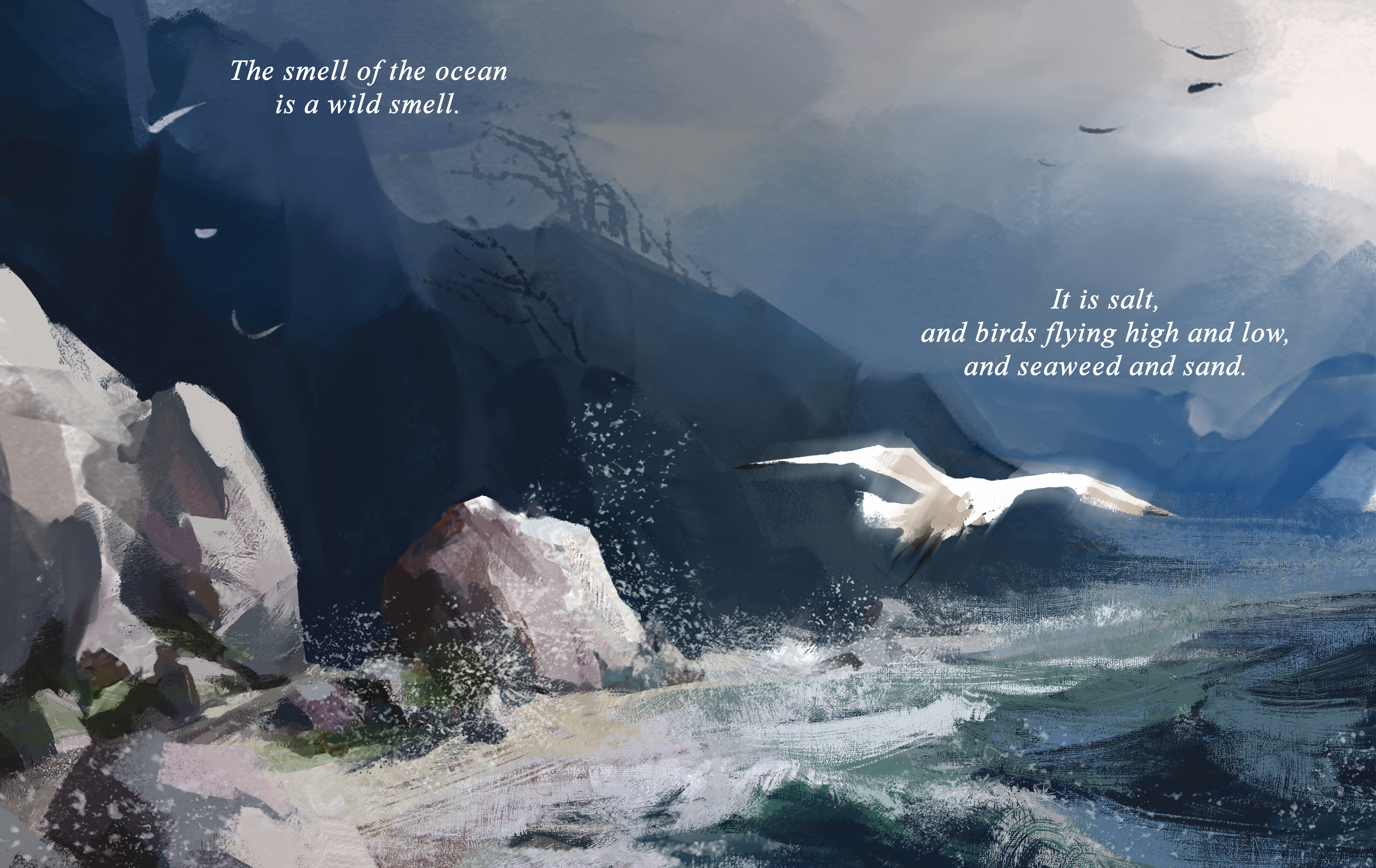
Here, then, are two more of the illustrated spreads featuring illustrator Tomasz Mikutel's breathtaking paintings (and my words).


The following retailers are among those carrying the book.

Amazon

Bookshop (hardcover only, so far)

Books-A-Million (hardcover link)

Powell's Books (both hardcover and paperback, though the book cover doesn't show in the listing)

Barnes & Noble will have it when (I'm guessing) the corrected cover is approved.

Also, your local bookstore should be able to order it. (For reasons having to do with pricing and wholesaler discounts, they may be more eager to order the paperback, but still willing to order the hardcover.) And I'd love to have you ask them, as a few such requests may induce them to carry the book regularly.

Happy reading and art enjoyment, everyone!

Saturday, May 14, 2022

More of the art from WIND, OCEAN, GRASS, and -- what I meant about collector's items

 Here are two more of the illustrated spreads (with words) from my new picture book Wind, Ocean, Grass, to be "released" tomorrow and already available in paperback from Amazon.


And there's so much more! (To be precise, forty more spreads than I've posted here so far.)

Now, about that "collector's item" hint.

After various angst-inducing episodes, I finally had the paperback and hardcover editions finished, uploaded, and approved. So I ordered some author copies . . . and didn't actually proofread the back cover for another few days, at which point I discovered to my horror that there was a typo in the text. It wasn't the sort of typo that leaps out at you, necessarily, but it was there. (I'm not identifying it, for a reason I'll get to it a minute.)

I was able to generate a new back cover pretty quickly -- quickly enough that the paperback edition could still come out on Amazon without delay. However, the hardcover edition, and the paperback edition distributed elsewhere, have a considerably longer maze to get through. In the meantime, copies with the typo have already been distributed to various retailers. Not until the corrected version makes it through the approval process will the distributor even start sending it out. I'm hoping this happens within the next couple of days, but have no guarantees. (It may, for example, be stalled over the weekend.)

So . . . if you buy the hardcover anywhere, or the paperback anywhere but Amazon, you just may be one of the lucky few to obtain the original version, typo included. Presto, a future collector's item! -- potentially, at least.

As for the typo itself: if you buy a copy (again, other than the paperback available from Amazon) before the corrected version completely replaces the original, you can entertain yourself looking for it. Call it a treasure hunt.

Tomorrow, I'll celebrate Release Day by posting more of the illustrated spreads. And once you get hold of the book itself, I promise all the cryptic bits of text you've seen here will make sense.

Friday, May 13, 2022

I Can Call a Picture Book Gorgeous Even If I'm the Author, Because I'm Not the Illustrator

 (Actually, I'm all in favor of people owning their achievements. Theoretically. In practice, I'm . . . getting better at it.)

My latest picture book, Wind, Ocean, Grass, has a release date of Sunday, May 15th, but the paperback is already available on Amazon. And it is gorgeous! Tomasz Mikutel, the illustrator, is a painter, exhibiting in galleries. He calls his style "classic and traditional" but also "loose." I call it -- or at least, the wonderful work in this book -- impressionist, or something close to it.

Here are a couple of the double-page spreads (with text included). See what I mean?


I'll post more tomorrow and on Release Day.

So what is the book about? Well, here's the description I've been using on Amazon and elsewhere.

-----

This unique picture book has neither human nor animal characters, but instead features the wind speaking to the grass, explaining how long grasses are both like and unlike the waves of the ocean. Through lyrical prose and breathtaking impressionist-style paintings, the reader follows the wind’s journey over sea and land: the many moods of the ocean, the different seasons of the grassy field. We see glimpses of the birds that live off the bounty of the ocean, and the birds and flowers that live among the grasses.

Through this nature metaphor, the story, without becoming didactic, teaches children about seeing commonality and celebrating differences.

-----

There are some complications about which versions will be available outside Amazon when. I'll explain next time. Hint: collector's items!

Tuesday, February 08, 2022

A snippet from upcoming-I-hope near-future novel DONATION -- featuring my favorite fictional judge

I hope, and just about believe, that after much dithering and changing course, I'll finally be publishing my near-future novel Donation this coming spring. And here's a snippet.

Donation involves the issues that arise when the federal government controls artificial womb technology. In this scene, federal judge Alexandra (Alex) Rayner examines some papers filed in a lawsuit where a woman who "donated" her embryo (now a fetus) is trying to regain her parental rights, and the Bureau of Reproductive Safety is fighting her tooth and nail.

I adore Judge Rayner. As one character says, she's what I'd like to be when I grow up -- or would be if I weren't more comfortable these days writing books.

--------

Judge Alexandra Rayner sat back in her rocking chair, luxuriously comfortable in her long bathrobe, quilted slippers on her feet – she’d finally found slippers neither too short nor too wide! -- and contemplated the opening motions in what promised to be a most interesting case. Interesting, and in unfamiliar territory: federal judges like herself were rarely drawn into family law disputes. Only the fact that the clinics were established under the aegis of the federal government had brought this matter to her court.

There was, of course, the threshold question: should she recuse herself because of the abortion all those years ago? She thought not. She had made that choice in a very different world, a world with different options and different consequences. That history did not predispose her to take any particular view of the present controversy.

So. The plaintiff wanted the adoption process frozen. Problematic, at least if continued for long, given Alex’s inability to freeze fetal development to match.

The plaintiff also wanted an order giving her access to the incubator, so she could talk to the fetus. Meanwhile, the clinic, should Alex decline to dismiss the case immediately, wanted carte blanche for the chosen adoptive parents to do the same, pointing out that for them to do so was normally routine. (And just when had those parents been chosen? Not that it mattered for her purposes.) She would ask for affidavits from experts about the importance to and effect on the fetus of hearing voices that could eventually be familiar and familial. And what about other voices? Did the nurses, or technicians, or whatever they were called talk to the incubators? How much? Were human voices in general more important than particular voices? Did even the experts know? Well, whether or not they knew, they’d try to sound as if they did.

Hmmm . . . That would be a possible solution. Indeed, uniquely rational. If the affidavits supported the claim that human voices, or the voices of family members, played an important developmental role, then the parties — plaintiff and individual defendants — could supply the same. Separately, and taking turns.

She could wish to be a fly — a temporary and sentient fly — on the wall when these competing would-be parents had their visits. What would they want the fetus to hear? What would they be unable to keep themselves from saying? Such knowledge would be helpful indeed, if her job was to play Solomon and send the baby where it would be best nurtured and loved. But she had no such mandate, and thank God for that.

Though come to think of it, Solomon had been asked to determine, not the best mother, but the true one. Maybe not so far, after all, from her own more legalistic duty.

And this degree of woolgathering meant it was time she went to bed. But first, she would send herself a note as a reminder. If she did order access to the fetus, she had better make sure the clinic did not take advantage of the logistics to record or listen in.

--------

Back to final(??) revisions. Wish me luck!

Sunday, November 28, 2021

The Problem With Pronouns

 I have been struggling for several years to become consistent at using "they/them" pronouns for someone I love, someone I've known almost half my life. During almost all that time, I and others referred to this person with "she/her" pronouns. I don't give a damn what, if any, gender this person is. The struggle arises from other factors.

I grew up speaking English. Like many of you -- including the person in question -- I have studied another language. So I have some appreciation of the profound differences between speaking one's native tongue and speaking a language in which one is not fluent. I believe these differences explain why changing my pronoun usage has been so difficult. Caveat: I'm not a scholar in linguistics or any related science. I'm describing an experience, one which I've done my best to study from the inside. (Second caveat: the English people under thirty-ish have learned may well be more flexible in structure.)

When I speak English, the basic building blocks require no conscious thought or effort. Verb forms, the ordering of parts of speech, and other such features of the particular language I speak -- all these fall into place at what I'll call a pre-conscious level. And from what I can tell, pronouns fall into that category. In the English I learned in the mid-1950s, the English in which I'm fluent, a single known human being takes the "he" set or the "she" set of pronouns. (Unknown humans are another story. I don't know whether, at some time before my era, using "he" for all unknown individuals was automatic, but it isn't for me.)

So, the building blocks are in place. Next comes adding the substance of what I want to say. This does require conscious choices. Even more deliberate is the next layer, one of nuance. Does the word that has come to mind have the right connotation? Is it sufficiently evocative? Will it fall pleasantly on the ear?

The final step, if I'm to use "they/them" for a single known person, amounts to slapping a filter on the top of this stack of words and meaning. It's the very last step before I open my mouth. Indeed, it often comes a fraction of a second later, and what I say comes out with hitches and interruptions, last-minute saves. 

Here's the ironic and most upsetting aspect of this process: the more I care about the content of what I'm saying, the more emotional significance it has for me and for the person I'm saying it to, the harder it is to remember to add that filter. So the more it matters, the more likely I am to sabotage the communication and hurt someone I love.

I understand, at least to some extent, why pronouns matter so much to this person and others like them. (Phew! Got it right that time.) Gender is a deeply personal matter, and being referred to with the wrong pronoun -- at least, for this person and many others -- feels like an attack. They don't see the errant "she" as just a part of speech. They view it as an insistence that what they know and feel doesn't matter. And even if it happens rarely, just knowing that it could happen means that every minute in the unreliable speaker's company is an ordeal of continuous stress.

I wish this person would make their own attempt to understand. And I have a more desperate wish, even less likely to be granted: that they, and others facing the same impasse, could revisit the symbolic heft they accord pronouns. Giving pronouns such power makes no-win situations, broken relationships, and broken hearts nearly inevitable.

Friday, November 12, 2021

A wonderful passage that applies to writing stories

 I just came upon a wonderful quotation in a wonderful book -- Once Upon a Wardrobe by Patti Callahan. It concerns George, an eight-year-old boy who is very ill, and who greatly cherishes C.S. Lewis's The Lion, The Witch and the Wardrobe. (It twinges a bit for me to resist putting in an Oxford comma.)

"George knows you can take the bad parts in a life, all the hard and dismal parts, and turn them into something of beauty. You can take what hurts and aches and perform magic with it so that it becomes something else, something that would never have been, except you make it so with your spells and stories and with your life."

This speaks to me as a writer, and may similarly speak to other writers, and to those wrestling with those hard and dismal parts of life.

Tuesday, October 26, 2021

Release Day!! for picture book WHEN IT'S WINTER

The wait is over! If you like winter, cute kids, cute dogs, and/or picture books with lovely illustrations, I hope you'll check out my newly released When It's Winter with illustrations by Barbara Dessi. I've been previewing pics and text alternately over the last few days (just scroll down), and I hope I've whetted your appetite.

Here's the cover, once again.


Here's the blurb.

"What makes winter special? This picture book celebrates the many fun activities and sensory experiences of the season. Follow a girl and her dog through the play and discoveries of a snowy day, and on toward bedtime.

"The first person narrative will encourage new readers to claim it as their own. The repetition of the phrase 'When it's winter . . .' will encourage children to chime in, and be of assistance to early readers."

And here's the Amazon link! (It may take you to the Kindle edition instead of the paperback I've told it to use, but you can get over to the paperback with one click.)

When last I checked, "Look Inside" wasn't yet functional for the Kindle ebook. If you encounter that problem, feel free to email me at kawyle@att.net, and I'll send you the first couple of illustrations. (You could also "look inside" the paperback, though it'll display single pages, i.e. half of the illustration at a time.) (Of course, you could just buy the book . . . . 🙂 )

Happy reading, all!


Monday, October 25, 2021

One more advance look before Release Day!

 Only one more day before the release of When It's Winter, the picture book on which I collaborated with the wonderful Barbara Dessi! Here's a final advance peek at Barbara's wonderful illustrations.

The book follows a day-long arc, and this image comes close to bedtime. I love everything about it.


Sunday, October 24, 2021

a peek at another line from upcoming picture book

 In keeping with my pattern of alternating looks at art and text in my upcoming picture book When It's Winter, here's another line.

------

When it's winter ... my dog helps me make a snowman.

------

(The illustration for this line is one of my favorites, but you can see that soon enough, with the book's Amazon release scheduled for Tuesday, October 26th.)

Tomorrow, another picture!


Saturday, October 23, 2021

next advance look at illustrations in upcoming When It's Winter picture book

 Here's another advance look at Barbara Dessi's lovely illustrations for When It's Winter! My only challenge is deciding which ones to share before the book comes out (Amazon's Kindle and paperback editions) next week.

And I've chosen . . . this one!


Tomorrow, I'll share another line from the book. And two days after that, if all goes as it should (fingers, toes, and eyes crossed), the book will be available on Amazon.

Friday, October 22, 2021

another advance look at the picture book When It's Winter

 I've decided to do something a little different this time as I lead up to, or count down to, the release of When It's Winter. (That'll be the release of the Kindle and paperback editions on Amazon, with wider release of the paperback, and a hardcover edition, to follow when logistics permit.) I'm alternating advance peeks at illustrations and at text.

Today's line:

--------

When it's winter ... I can make a cloud just by breathing.

--------

What did illustrator Barbara Dessi do with this line? And what part will the little dog play? You can find out in just a few days!

And since I hate to end this post without including any art, here's the cover again. 


Thursday, October 21, 2021

Announcing the release date for picture book When It's Winter -- on Amazon, at least -- and pre-release plans

 After some dithering, I've decided to release my picture book When It's Winter, illustrated by Barbara Dessi, in five days, on October 26th. That is, I'll be releasing it on Amazon. I would love to release it on IngramSpark as well, in the hope of interesting some bookstores -- but it appears I won't actually receive the physical proof copies of either the paperback or the hardcover edition until mid-November or later. I am restraining myself, just barely, from releasing IngramSpark's version of either edition sight unseen.

Wish me luck! Patience has never been my strong suit.

In the meantime, I'll post a few advance peeks at illustrations in the days leading up to the release, in order of their appearance in the book. (I already did a cover reveal in a previous post.)

Oh, okay, here's the first one . . . .


What do you think the text is for this winter scene?

By the way, the dog shows up in almost every spread. 🙂


Tuesday, October 12, 2021

Picture book cover reveal!

 I don't have a firm release date, for various logistical reasons, but sometime this month (Fates willing), my picture book When It's Winter will make its appearance. And here's the front/Kindle cover!


As you can see, it's illustrated by Barbara Dessi, and I'm delighted with what she hath wrought. The book will be available in Kindle, paperback, and hardcover editions.


Friday, July 30, 2021

Closest to the Fire: A Guide to American Law and Lawyers is now available!

 One last fanfare from the weary trumpeter who heralds my new releases, with this third release in just over three weeks . . . .

After belatedly admitting to myself that my 2015 nonfiction book, Closest to the Fire: A Writer's Guide to Law and Lawyers, had an unduly limiting and therefore misleading subtitle, and after keeping track for six years of all the updates the book could use (and posting them on the book's website), there is finally an updated and somewhat retitled edition. Closest to the Fire: A Guide to American Law and Lawyers still has plenty of tips and story ideas for authors and aspiring authors, to help them get their legal facts straight and explore the less drearily common legal plots and settings -- but I hope the revised title will now offer a clue of the book's value to law students, other students, visitors to this country, and any Americans who want to better understand the legal landscape in which they live.

As the only slightly overblown back cover copy says: ""The legal landscape can be a minefield. Here's a map."

The book is meant to be consulted in any order the reader chooses, with the Table of Contents and Index as a guide -- but I've been told by readers of the 2015 edition that it makes surprisingly entertaining reading, even starting from the beginning and plowing on through.

Here are the links to the book on Amazon -- including Kindle Unlimited -- and Barnes & Noble. Happy reading!

Thursday, July 29, 2021

last pre-release excerpts from Closest to the Fire: A Guide to American Law and Lawyers

 I wasn't sure what excerpt or excerpts to include in this final pre-release post. In the end, I decided on two excerpts, the first having to do with what juries can get away with.

-----

G. Jury Nullification and Other Shenanigans

One open secret about juries is that in criminal trials, jurors don’t have to do as they’re told. This is a big part of why we have juries at all. They’re a failsafe against laws that may be unduly harsh or out of step with current societal values. If the law is unjust, the jury may simply refuse to apply the law. Such a refusal is called “jury nullification.” This power can be extrapolated from several U.S. constitutional provisions. In addition, four states, Georgia, Indiana, Maryland, and Oregon, have state constitutional provisions or statutes saying the jury is the judge of, or has the right to determine, both “the law” and “the facts” of the case. (In Indiana, it’s Article I, §19 of the state constitution.) Twenty more states have more limited provisions that apply to civil suits for libel, presumably due to the importance those states accord to freedom of speech.

Judges, understandably, would just as soon that jurors didn’t know they have this option. The defense generally won’t be allowed to argue that the jury should ignore the law. The most the defense may be able to do is get a jury instruction (see 27.B.) citing the “judge of the law and the facts” language if it exists in that state — and then largely contradicting it by saying that the jury should follow the law as the judge has explained it to them. **A clever defense attorney might be able to hint, just enough, at the possibility of jury nullification that even if the trial judge intervenes and tells them to ignore what the attorney said, the jury will have picked up the clue.**

(There's also something called "jury vilification" -- but it's something a judge does. If a judge unjustifiably ignores a jury's verdict, e.g. by directing an acquittal after the jury has convicted when the evidence could justify conviction, that's jury vilification. See 5.C. re judicial misbehavior.)


If a jury does break the rules, it’s not so easy to do anything about it, especially if the verdict’s already in.

During a trial, including while the jury is deliberating, there are various things a judge can do if informed that a juror has misbehaved. If, for example, some other member of the jury reports that a juror has hidden a powerful motive to rule for one party or the other, or has done significant research into some factual or legal issue, the judge may dismiss that juror and interrogate the other jurors to see whether their own ability to deliberate impartially has been affected. The judge could admonish (lecture) the other jurors, reminding them of their duty, or could even surrender and declare a mistrial (see 9.D.). It’s anybody’s guess what most judges would do if confronted, mid-trial, by the knife-shopping expedition out of which Henry Fonda’s character made such hay in Twelve Angry Men. Different judges will allow different amounts of latitude to juries who perform experiments with items already in, or similar to items in, evidence. **But one could base a story on such events, aiming for anything from farce (“but Henry Fonda did it!”) to tragic irony (e.g. an acquittal prevented by a mistrial, followed by conviction of the innocent defendant in a second trial).**

-----

For my last pre-release excerpt, I'm serving up a rather timely discussion about the First Amendment to the U.S. Constitution, and what it actually protects.

-----

1. The First Amendment

The First Amendment plus the Fourteenth (see the intro to this chapter) prevent the federal, state, and local governments and their agents from:
>> “establish[ing]” any religion;
>> “prohibiting the free exercise” of any religion; 
>> “abridging” the “freedom of speech,” the “freedom of the press,” “the right of the people peaceably to assemble,” and the right of the people “to petition the government for a redress of grievances.”
None of these restrictions on government power are straightforwardly defined, and the definitions keep changing. What government actions constitute an “establishment of religion” is a particularly tangled thicket, with frequent litigation about whether a town hall may open with a prayer (currently, yes, if the prayers are theoretically open to all religions) and whether religious symbols such as Nativity scenes may be erected with public funds or on government property (currently, no, unless there actually are a variety of comparable secular displays in the same location as well).

[. . .] 

Freedom of speech covers only government restrictions on speech. If, for example, a magazine refuses to publish certain points of view, that’s not “censorship” in the sense of a violation of the First Amendment: the magazine, as a private entity, has every right to decide what speech it will tolerate.

The definition of “free speech” has been stretched over the years to include a good deal of nonverbal-but-expressive conduct, such as nude dancing (if the context is arguably artistic). It can also include loudly airing one’s displeasure at what a police officer is doing, though at some point such conduct could shade over into “disorderly conduct,” “disturbing the peace,” or interfering with the officer’s performance of their duties” (see 13.O.). When someone yells obscenities or insults at a police officer, states may differ as to whether police officers should be treated as having a higher threshold of endurance than the general public. More generally, there is often a two-stage analysis:
1. Did the state (or municipality) restrict expressive activity?
2. Did the defendant “abuse” their free speech rights to the point that they’re no longer protected?
The court may combine several balancing tests, looking at how much the state interfered with the speech, and at how much of a nuisance or injury the defendant’s conduct imposed on bystanders, nearby property owners, etc. If the speech had political content, even if liberally larded with obscene emphasis, the state will have to show more in the way of damage done.

Free speech definitely includes expressing unpopular and “offensive” opinions and trying to persuade people to come around to those opinions. That’s why rules that try to “protect” students at public universities from being offended or upset run afoul of First Amendment concerns.

What about “fighting words”? The idea that some insults provide so much provocation as to put them outside First Amendment protection came from the 1942 Chaplinsky case, in which the U.S. Supreme Court held that calling a city official a “damn racketeer” and a “damn Fascist” fell into an unprotected “fighting words” category. [. . .]To the extent the “fighting words” doctrine survives, it now refers only to personal insults directed at specific people, and does not allow even those insults to be punished under statutes that could also be used to punish a broader variety of offensive statements.

State and lower federal courts have often disagreed as to just what insults may still be treated as crimes. As already mentioned, there may be a tendency to treat insults directed at police officers as constitutionally protected comments on governmental activity, where the same insults aimed at a private citizen would have no such protection.

Some state college administrators, whose colleges come within the rules for governmental institutions, fall back on the fact that the Supreme Court never explicitly overruled Chaplinsky as allowing them to prohibit “offensive” speech. This argument has not fared well in the courts.

Another much-misunderstood notion is “clear and present danger,” for which the best-known example is shouting “Fire!” in a crowded theater. This example was used in a 1919 U.S. Supreme Court case that actually involved a very different sort of speech, namely encouraging young men to resist the draft during World War I. (This period was not exactly a high water mark for U.S. civil liberties.) If speech posed a “clear and present danger” of leading to consequences the government could legitimately seek to prevent, it could be prohibited and punished.

The Supreme Court overturned this ruling around fifty years later. Abandoning the “clear and present danger” standard, the Court held that speech could not be made illegal unless it incited “imminent lawless action.” “All of you go out right now and burn down the theater!” would presumably qualify.

-----

That's all! I hope these excerpts have been interesting and/or informative -- and that they've whetted your appetite for more. If you want to know about the many, many subjects from which I haven't taken excerpts, then tomorrow you can use "Look Inside" to see the Table of Contents on Amazon -- or, of course, get the book there, or at Barnes & Noble, or anywhere else you find it. (There may be a delay in the Kindle edition, for reasons too dull to relate. And whether there will be a non-Kindle ebook edition is currently uncertain.)

Wednesday, July 28, 2021

A short and a longer excerpt from this coming Friday's nonfiction book release

 Two excerpts for the (nonexistent) price of one today -- a short introduction to the section on the pace of legal proceedings, and a longer (all right, long) look at RICO (the federal Racketeer Influenced and Corrupt Organizations Act, which now extends far beyond its apparent context).

Here's the first:

------

A. Intro: "Abandon All Hope "

Lawsuits are hell. Or would be, if Hell were expensive.

Like Hell, they last forever.

Like Hell, they often end up making you regret whatever you did to get there.

I’ve sometimes thought that every courthouse door should bear the same inscription that greeted those entering Hell in Dante’s Inferno: “Abandon all hope, ye who enter here.”

That’s obviously an unfair and jaundiced view. As I said earlier, the judicial system, with all its faults, is a better way to resolve disputes than, say, mortal combat. Sometimes, justice is done, and done without overwhelming unintended consequences for the parties.

But if an author is going to write about litigation, they should keep in mind the enormous financial, logistical, and emotional burdens involved. And anyone with a choice about whether or not to embark on litigation should think very carefully about that choice.

-----

And the second:

-----

C. You Too May be Treated Like a Gangster: RICO


It all started with some very frustrated law enforcement folks. They were having a devil of a time getting juries to convict gangsters. Oh, they finally got Al Capone on taxes, but wasn’t there some easier way?

Enter the Racketeer Influenced and Corrupt Organizations Act (RICO), in 1970. RICO was designed to make it easier to convict participants in organized crime by focusing on how organized crime actually functioned, and to nail the kingpins rather than just the small fry actually doing the murder, shakedowns, pimping, drug dealing, etc. It did this by:

>> Focusing on “patterns of racketeering.” This was supposed to mean multiple violations of the sort of laws organized crime might violate in the regular course of business.

>> Including those who initiated the criminal activity, even if they weren’t out on the streets committing violent acts and so forth.

>> Providing for pretrial restraining orders seizing the assets that would otherwise pay for the finest criminal defense teams.

 At some point after RICO was passed, and certainly by the 1980s, the feds figured out that RICO could be a handy tool well outside its original context.


Various portions of RICO deal with investing proceeds from a pattern of racketeering in an “enterprise,” or using such proceeds to maintain an interest in the “enterprise,” or conducting the affairs of an “enterprise” through a pattern of racketeering. Most courts require the defendant to be someone or something other than the “enterprise,” though the minority view has been gaining adherents. Where there’s a requirement of two separate participants, that requirement may be satisfied even if there’s only a sole proprietorship involved, if there’s some formal separation between the individual and the business or if the business has employees. Where a corporation is the target, sometimes the corporation is the “enterprise” and its officers or employees are the participants. Where a civil suit is contemplated, this may raise the tactical problem of whether the lawsuit is financially worthwhile, since many courts won’t allow the use of a “respondeat superior” approach (see 14.Q.) to let the plaintiff sue the corporation for its agents’ misdeeds.

So what makes up a “pattern of racketeering activity”? A business (again, potentially including an individual in business as a sole proprietorship) may be accused of violating RICO if it uses the U.S. mail or telephone twice in 10 years for a “predicate act.” A “predicate act” is any of a list of underlying crimes that might not be so serious, if RICO wasn’t available to ratchet them up. Use the mail or the phone at least twice in 10 years for one of these acts, and that’s deemed a pattern of racketeering activity.

What are these predicate acts? There are many, and some are awfully easy to commit. Here are a few examples of some “predicate acts” that may not immediately make you think of gangsters and the like:

>> Selling (or maybe just distributing) a video of a live musical performance without permission.

>> Using income that came from collection of a gambling debt, if the gambling involved violated any federal, state, or local law, in interstate commerce (which includes a whole lot of types of economic activity).

>> Using income from “usury,” charging more interest than some law allows, to acquire any interest (such as corporate shares) in any entity involved in interstate or foreign commerce.

>> Selling goods or services with counterfeit trademarks.

>> Obstruction of justice, of an investigation, or of state or local law enforcement.

>> Making a false statement in a passport application.

>> Interstate transportation of a stolen car or other stolen property.

>> Criminal infringement of a copyright.

>> Violating restrictions on payments to a labor organization.

>> Harboring an illegal immigrant.

>> Conspiracy to participate in any of these (or the many other listed) acts.

Some of these federal crimes may, for a criminal conviction, require proof of some sort of intent — but under RICO, the only elements the prosecution must prove beyond a reasonable doubt, the usual standard for criminal prosecutions, are the “pattern” elements. The underlying crime, the predicate act, need only be proved by only a preponderance of the evidence! (Yes, I find this shocking.) 

Also, as already mentioned, under RICO the feds can seize or freeze all the assets of the business involved at the time of indictment, before any proof that the predicate act has been committed. Those assets may be the defendant’s only chance of hiring a sufficiently able and experienced attorney. The pressure to accept a plea bargain can thus be overwhelming.

The penalties for violating RICO include very long prison terms and forfeiture of assets unrelated to the criminal activity.

As mentioned above, RICO also has a civil side, allowing suits in both state and federal court. A successful plaintiff can collect treble (triple) damages (see 30.B.3.). One new twist recently in the news: some spouses of the wealthy, claiming that their spouses have hidden assets, are trying to pull their divorce actions into federal court and use civil RICO. This hasn’t succeeded so far, as far as I know, but stay tuned.

RICO has been used against many organizations unrelated to organized crime, including Catholic dioceses, Major League baseball, companies that hired illegal aliens, and anti-abortion activists who blocked entrances to abortion clinics.

-----

One more day of excerpts, and then the book! -- which, by the way, one can preorder on Amazon and on Barnes & Noble.