Tuesday, August 30, 2022

First excerpt from fourth book in Cowbird Creek series -- plus a request for early reviewers

 Hello again! I'm hoping to make What Wakes the Heart (Cowbird Creek 4) available in about a month and a half, so it's high time I tried to whet your appetites for it. I also have a secondary purpose: I seek early reviewers! If I find any who like the book and don't mind being quoted, their kind words could end up on the back cover of the paperback edition, as well as on the book's Amazon and other pages.

So without further ado, here's an excerpt from Chapter 1. 

-----------------------------

[Susanna Shepard has just graduated from a “normal school” (teacher’s college) in St. Louis, MO. The president (aka principal) has asked her to come see him to discuss some possible “good news.”]

 She knocked, her breath coming short as she strained to hear any word from within. Almost at once, the door opened, and there he stood, smiling broadly, his gold tooth glinting. “Susannah, my dear! Come in and sit down. You may hang your bonnet on the peg.”

The suggestion further buoyed her spirits. Clearly Mr. Brecker had not invited her simply for a short social call, but had matters to discuss that would take some time. She would like nothing better than to follow his instructions, but he had hardly left room for her to enter. She searched for the words to say as much, but in a moment he stepped back enough for her to get by. Once she had hung up her bonnet as instructed, he waved her toward the chair at one side of his desk, then walked around behind her toward his own. Something brushed her hair as he went by. His waistcoat? But it had been buttoned snugly around his midriff.

Mr. Brecker sat down, the springs in his chair squeaking under him, and leaned toward her. “As I told you on Saturday, I have some news that should be welcome — though not surprising, for such an able scholar as yourself.” He paused, looking at her intently, and cleared his throat before he went on. “You may recall that my own sister is in charge of an excellent school in this very city, a school much prized by parents, to the point where they are happy to pay the fees necessary to maintain its quality and keep its facilities in good condition. There is rarely a vacancy among its staff, for none leave without pressing need, but it just so happens that one of the instructors is shortly to be married and will be departing.”

He paused again. Was he waiting for her to express interest? Her interest must be obvious. But she asked, as he appeared to wish, “How is this instructor to be replaced?”

He studied her, for what purpose she could not guess. “While the final decision will of course be my sister’s, she is naturally inclined to rely on my judgment. If I recommend you to her, I am confident your acceptance — and your future — will be assured.”

He would hardly have called her here and given her this news if he did not mean her to have the post. But he had not yet said as much. What remained for her to do or to say? “Indeed, sir, I would be very happy and grateful if you see fit to recommend me.”

He leaned back in his chair, pushed it a little ways back from the desk, and licked his lips. “Come here, my dear.”

She wrinkled her forehead, an action which suddenly reminded her of the lines in her mother’s face. “Sir, I am not sure what you mean.”

He stood up, passed behind her again, and shut the door. Then he came back and stood next to her chair, holding out his hand. “Your gratitude is to your credit. Gratitude is a virtue we teachers prize, when we have done well by our pupils.” As she sat looking up at him, he leaned down and picked up her right hand, pulling her upward. His hand felt warm and surprisingly soft. “I know you must be anxious to express it.”

Once before, or it might have been twice, Susannah had noticed men in the streets following her with their eyes, looking at her with something between need and greed. Mr. Brecker’s eyes held that look now. He pulled harder on her hand.

Susannah rose out of her chair — and moved away, tugging her hand free of his grasp. “Mr. Brecker, I would of course be grateful for any assistance you give me, so long as it is based on my merits. When would it be possible for me to meet your sister?”

He seized her hand again and pulled hard, so that her bosom touched his broad chest. “My dear, your maidenly reserve does you credit. But you must trust me to do what is best for you, to guide you.” He slid two fingers into her hair and drew out a strand. “So fine a color. I have always favored dark hair. And yours, my dear, shines like a blackbird’s wing. And your eyes are as green as the fields of heaven.”

She could feel the blood blazing in her cheeks as she shoved herself free. She must say something, but what could she possibly say? Had she misunderstood? But what could he possibly mean, but what it seemed?

She looked back at him, hoping to see confusion, or even hurt. But it was anger that narrowed his eyes and tightened his mouth.

Susannah backed away until she could feel the doorknob in her hands. Then she spun around, grabbed her bonnet with one shaking hand, yanked open the door, and ran down the hall, like a child running from some dread thing.

---------------------------

Please email me at kawyle@att.net (best option) or comment below if you're interested in reading and reviewing this book as soon as it's ready!

I'll leave you with a repeat look at the cover.


Next time, an excerpt from the point of view of the young man on the left!


Wednesday, August 24, 2022

The Crucial Importance of Vetting a Potential Editor

 This blog post began life as a book review.

I bought a science fiction novel because its description intrigued me and it was on sale. (This is how I buy a great many ebooks. The rest usually come from a favorite author, like M.C.A. Hogarth, Grace Burrowes, V.E. Schwab, Lois McMaster Bujold, or my latest discovery, T. Kingfisher.) It didn't take long for me to discover that the book was exceptional -- in an unfortunate way. It was full of a great many errors, the kind that an edit should catch: mostly errors of grammar and vocabulary, but also continuity issues (not so much outright continuity contradictions as implausible shifts in attitude and expectation), ridiculous similes, and the occasional typo. I kept reading only because, underneath the absolute mess of the text, a somewhat interesting (if a bit derivative) story struggled to be told.

After a few chapters of this, I looked back at the front matter and saw that an individual editor was not only credited, but thanked for her impact on the finished product. The wording suggested a possibility even more unsettling than the editor's simple (if staggering) incompetence. Could the editor have taken a less problematic text and added some of the errors? Particularly where the misuse of words was concerned, I found it plausible that the author might have had a more limited vocabulary and/or a lack of confidence in her knowledge, and therefore accepted the editor's egregious substitutions.

I don't usually leave reviews that are primarily critical, though I'll mention what I see as weak points in a book I otherwise enjoyed. I was going to make an exception in the case of this book, as a warning to authors -- particularly new indie authors -- not to accept credentials or recommendations as a substitute for a test edit. Only a test edit can show whether a particular editor (a) is basically competent and (b) understands your authorial "voice" and will refine it rather than trying to replace it with some other style.

And then, the lawyer in me spoke up. (Yes, I'm an actual lawyer, though I'm quasi-retired.) If this review came to the attention of the book's editor, that editor might sue me for defamation (slander or libel, the latter for writings) -- even, possibly, for "defamation per se," which (among other things) covers defamation that could damage the subject's livelihood, and doesn't require proof of actual damages. I should be able to prevail in such a lawsuit, but it would be a waste of time and money, particularly if I did what prudent lawyers do when sued and hired some other lawyer to assist me or to be lead counsel.

So instead of leaving a review or otherwise identifying the book in question, I'm using this blog post to make my point more directly. For pity's sake, don't turn over your precious book to an editor who may let obvious errors go uncorrected or, worse, hand you back an unrecognizable Frankenstein's monster. (And if you answer this advice by pointing out that traditional publishers are unlikely to give most authors a choice of editor, you'll be quite right. Not every book that comes out of traditional publishers is well edited, let alone edited with sufficient care for the unique aspects of the author's voice. Indie authors, however, can vet editors.)

If I'd left a review, that review might have alerted the author to her predicament. I'm sorry not to have accomplished that. But who knows -- maybe the author and I will both be lucky, and she'll see this post and realize that it could apply to her.

Tuesday, August 23, 2022

Cover reveal! for fourth book in the Cowbird Creek series

 It's hard to type with crossed fingers, but here's hoping the beta reader feedback on What Wakes the Heart, the fourth book in my Cowbird Creek historical romance series, won't do major damage to my intended release timeline. If all goes reasonably well, this book will come out by mid-October of this year. So this seems like a good time to reveal the cover, previously shown only to family and my newsletter subscribers.


Just who are we looking at? Well, that's Susannah on the right, who will be the first schoolteacher for Cowbird Creek's first school. The fellow on the left goes by the name John, but before emigrating from Poland, he was Jan (pronounced much like "yawn").

In the weeks to come, I'll post some excerpts.

Saturday, July 30, 2022

A warning about parental rights

 It occurred to me today that I should write down a concern I've had since Dobbs overruled Roe, even though it may never prove prescient. After all, one never knows when one will be hit by the proverbial truck.

The majority opinion in Dobbs stated emphatically that the decision had no affect on, and had nothing to do with, precedents (prior binding legal decisions) on issues other than abortion. The precedents in question, including those establishing the right to same-sex marriage and to use contraception, are, like Roe -- and more explicitly, Casey, which reaffirmed Roe decades later -- based on the idea of "substantive due process." The doctrine of substantive due process requires that one interpret the Fourteenth Amendment's phrase "due process" as involving more than simply process, or procedure, but also encompassing substantive rights -- or at least, the "fundamental" ones.

Troxel v. Granville, the Supreme Court case that for the first time explicitly protected fundamental parental rights in the concept of grandparent visitation, is also based on substantive due process, although the plurality opinion (there was no majority opinion) referred only to "the Due Process clause" without that revealing adjective. (Concurring and dissenting opinions did use the full phrase.)

Back to Dobbs. While Justice Thomas joined the majority opinion, he also wrote a separate concurring opinion in which he -- not for the first time -- criticized the notion of substantive due process, calling it "an oxymoron that lacks any basis in the Constitution." Thomas noted that no party to the Dobbs case had asked the Court to decide to reexamine all the Court's Fourteenth Amendment precedents. Therefore -- because this broader question was not presently before the Court -- he agreed that Dobbs didn't cast doubt on those other Fourteenth Amendment cases. But he stated that in future cases, the Court should (presumably, after this hint, with the proper briefing from the parties involved) reconsider all its substantive due process precedents. That would include Troxel, although Thomas did not include it in his list of examples.

Thomas went on -- again, not for the first time -- to mention the Fourteenth Amendment's Privileges or Immunities Clause, which states that no state may make or enforce any law that would "abridge the privileges or immunities of citizens of the United States." This clause was essentially rendered a dead letter by a series of late 19th century cases, at least as far as any rights not mentioned in the first eight amendments are concerned -- but it could be revived, particularly if "substantive due process" bites the dust. The question would then become just how many rights, other than those listed in the first eight amendments, are protected as "privileges or immunities." In his concurring opinion in Troxel, Thomas included a footnote stating that Troxel did not involve a challenge based on the Privileges or Immunities Clause, and thus did not provide an opportunity to reevaluate the meaning of that clause.

For what it's worth, I think that Justice Thomas's concurring opinion is more forthright on the subject of the non-abortion substantive due process cases than is the majority opinion. And I think that some enterprising grandparent (or other nonparent) will, sooner or later, challenge Troxel, and any state precedent based on Troxel, on the ground that its constitutional reasoning was flawed. (Note: some state supreme courts have found independent state constitutional grounds for protecting parental rights as much as, or more than, Troxel did.)

I therefore hope that in the meantime, those for whom a Supreme Court case gutting parental rights would be disastrous will prepare to fight for those rights using arguments other than substantive due process. These arguments should, I submit, include arguments in favor of rehabilitating the Privileges or Immunities Clause. I have the impression that plenty of scholars and historians have criticized the 19th century cases in question (perhaps appropriately known as the Slaughterhouse Cases) -- so arguments should not be too hard to come by. 

Whatever rights the Privileges or Immunities Clause might be held to protect, they are likely to include rights that (to quote some often-used language) are "objectively, deeply rooted in this Nation’s history and tradition." Parental rights should qualify.

Finally, whether or not a parent's state Supreme Court has already found that its state constitution protects parental rights, any parent facing the need to bolster state law on the subject should prepare to make a state constitutional argument.

Monday, June 27, 2022

How artificial wombs could provide an acceptable replacement for abortion -- depending on who controls them

 The title of this post more or less summarizes the starting point for my latest near-future novel, Donation.


I almost published this book a couple of years ago. I decided against it because it focuses on the misuse of artificial womb technology, and I didn't want to give the impression that I opposed the development of such technology (or of new technologies in general). I did some rewriting to make clearer, I hope, that I was warning about why we should hesitate to give control of large numbers of unborn children to government, especially to centralized government.

Until the leak of a draft of the Dobbs opinion, I didn't really think we'd see the demise of Roe v. Wade any time soon. Yet here we are. So the book has ended up being pretty timely. And I want to say again -- to emphasize -- that if we don't fall into the trap this book describes, prenatal incubators that can shelter and nourish fetuses and even embryos could be a way for women in "red" states to retain, or regain, their reproductive freedom. 

No solution is perfect, including this one. Some women would be haunted by the thought that a child of theirs was out there somewhere, and worry about that child's well-being (unless some sort of followup was allowed). But some women find themselves regretting an abortion. If I were still in my reproductive years and unable to raise the child I was carrying, I would much rather chose the incubator, if I could.

Sunday, June 26, 2022

A few thoughts about Roe v Wade and its demise, from a lawyer long interested in constitutional law

 A brief introduction, for those who've previously seen me post about novels and picture books: I'm also a lawyer with a decades-long interest in constitutional law. Before I started using this blog as a way to tell people about my books, I most often wrote on legal and political topics.

And now, I'm reverting to that subject matter to share a few thoughts about the Dobbs decision, which overturned Roe v. Wade and Planned Parenthood v. Casey.

This event -- Roe being overturned -- vindicates the wisdom of Ruth Bader Ginsburg, who noted the shaky legal (constitutional) basis of Roe and regretted that a political trend toward legalizing abortion had been interrupted by it. (And yes, in my view and according to many legal scholars and commentators, irrespective of their views on abortion, Roe had a shaky legal basis indeed.)That isn't to say some states wouldn't have continued prohibiting abortion right up to the present day, but we wouldn't have had decades of posturing for political benefit by people -- on each side -- who didn't have to face up to the reality behind the positions.

Also, if not for Roe, it's conceivable that some case(s) would have established a more solid constitutional basis for abortion rights. (See more on a related possibility below.) Theoretically, that could still happen -- the new Dobbs opinions could be distinguishable, in that no one involved in Dobbs made such alternate arguments. But I find it hard to imagine the Court bringing chaos to state abortion law again any time soon.

We may, however, see such alternate constitutional arguments made for other "privacy"/"substantive due process" rights such as gay marriage and parental decision-making authority. As for whether that will be necessary, I'm at least a little skeptical of the majority opinion's protestations that no such other rights are involved. As the Dobbs majority opinion notes, Planned Parenthood v. Casey, which reaffirmed Roe nineteen years later, relied on substantive due process. The cases recognizing gay marriage, parental decision-making rights, use of contraceptives, et cetera also shelter under that umbrella, in whole or in part. (Brief detour for legal explanation: the Fourteenth Amendment forbids states to "deprive any person of life, liberty, or property, without due process of law." This language has been stretched to include substantive rights, unrelated to procedure and not listed in the Bill of Rights or elsewhere in the Constitution, under the rubric "substantive due process," something of an oxymoron.)

Why do I doubt the majority's assertion that a decision on abortion, unique in destroying a potential human life, will have no repercussions for these other cases? Because the Dobbs decision doesn't actually rest on the fact that abortion destroys a potential human life. It does rely on various historical data specific to abortion -- but I consider it plausible to predict that future cases involving these other rights will, in examining comparable historical evidence, conclude that some or all of those rights are similarly without adequate constitutional foundation. I am not saying that will happen -- I haven't researched such history. But I don't entirely credit the way the majority brushes aside the possibility.

Justice Thomas's concurring opinion points out an important caveat. There may be other provisions, either in the Constitution as originally ratified or in one or more amendments, that could provide a basis for rights originally justified as aspects of substantive due process. Thomas mentions the Privileges or Immunities Clause, also part of the Fourteenth Amendment. He's consistently called attention to this clause over the years, so I doubt he's mentioning it simply as a hypothetical option.

Finally, on a less legalistic note, I'm glad to see that some anti-abortion activists are trying to make options and resources other than abortion widely available to pregnant women and to mothers, and aren't necessarily festooning such options and resources with religious slogans or indoctrination.

Wednesday, June 01, 2022

Official Release Day for near-future SF novel DONATION -- with one more excerpt

 It's the "release day" for Donation! That means that the Ingram Group, which handles distribution of the paperback edition to everyone except Amazon (where I put it up separately), has switched the book's status from "preorder" to "available." You can now order the paperback from such retailers as Barnes & Noble. If your local bricks-and-mortar store isn't carrying it, you can ask them to order it in.

Of course, the Kindle and paperback editions are still on Amazon.

I'm celebrating by posting one more excerpt. This one's from the point of view of Adam Brown, one of the adoptive parents the Bureau of Reproductive Safety has chosen to adopt Toni's child. It's perhaps unusually lively for an account of a lawyer preparing clients for a deposition. (A deposition is the pretrial examination of a witness who may or may not be called at trial, made under oath, but rarely in an actual courtroom.)

-------

When they had served their time in the waiting room and a receptionist admitted them to Mr. Voxsmith’s office, the lawyer immediately led them to a conference room whose furnishings struck Adam as unusual. The table was smooth, polished wood, an elegant oval, but the chairs were straight-backed wood with no arms and less than ample seats. Mr. Voxsmith waited until they had seated themselves, rather gingerly in Adam’s case, before he explained. “The plaintiff’s lawyer may decide to make you uncomfortable. I didn’t want it to take you by surprise, and you can practice ignoring it.”

Adam practiced ignoring the chair while the lawyer ran through some basic instructions. Common sense, mostly: don’t volunteer information; don’t answer unless you know the answer of your own knowledge; don’t guess what a question means; don’t lose your temper; tell the truth. As to that last, Mr. Voxsmith elaborated. “If you try to color the facts, let alone outright lie, then you have to remember what you said. That’s hard when you’re nervous, and lawyers are very good at making people nervous. And unless you’re habitual liars, lying is emotionally exhausting, especially if you have to do it over and over. And if you get caught — well, to use the precise legal phrase, you’re toast.

“Let’s move on from physical discomfort to other sorts. I’m going to start with some personal questions. I’ll point at whichever of you should answer — we’ll save time by skipping the Mr. This and Ms. That. Ready? Here we go.”

The lawyer pointed at Grace. “How long did you try to conceive naturally before giving up?” Then he looked not at Grace but at Adam, assessing his reaction. Adam had shifted in his chair and clenched one fist. The lawyer lifted an eloquent eyebrow; Adam forced himself to sit still with hands open on his lap.

Meanwhile Grace had started answering the question. “We tried for four years. But really, we’ve never stopped trying.”

Mr. Voxsmith, to Adam’s astonishment, took a kazoo out of his pocket and blew on it twice. “This is my buzzer. When you hear it, you know you screwed up somehow. Ms. Allen, you made two mistakes. You contradicted yourself, and you gave the enemy some ammunition. You wouldn’t necessarily find that out until the trial, when you’re on the stand and opposing counsel brings up that statement in cross-examination, asking why you’re insisting on seizing this poor woman’s baby if you haven’t given up on your efforts to conceive.”

Grace gulped and said, “What should I have said, then?”

The lawyer wagged his finger. “No, no. I can’t tell you what to say. That’s coaching the witness.” He turned toward Adam. “Mr. Brown, do you have any suggestions?”

Adam thought for a moment. “She could say that we tried for four years before deciding it just wasn’t going to happen. That’s true, even though we can’t help hoping a little bit anyway.”

The lawyer did not reply; apparently, the absence of a kazoo blast was sufficient approval. He pointed at Adam next. “Describe the methods you used in your attempt to conceive naturally.”

Adam couldn’t help staring. “Can they really ask me that?”

“They might. That or something else equally obnoxious. Partly in the hope of throwing you off balance. So — give.”

Adam gritted his teeth, then had to relax his jaw to answer. “Once we decided we needed help, we used two positions recommended by our fertility specialist.”

The finger stayed pointed at Adam. “Did you get a second opinion?”

“Ah — no.” As Adam opened his mouth to say more, out came the kazoo again. BLAT!

“Don’t guess at a followup question and then try to answer it.” Now it was Grace’s turn again. “What percentage of your annual income did you spend on your effort to conceive during those four years?”

Grace was good with numbers, both remembering them and calculating them. “Approximately fifteen percent.” How should Adam answer the same question? “I don’t know,” probably. Except now he did — he trusted Grace. But no, he wasn’t supposed to answer out of anything but firsthand knowledge.

Still Grace’s turn. “And what is that annual income?”

Adam blinked at Grace’s answer. Were they really doing that well?

Back to Adam. “Did you consider spending more?”

Had they? “I don’t remember.”

No kazoo. Good. Here came the next question, for Grace. And a gleam in the lawyer’s eye suggested it would be the nastiest one yet. “When you applied to adopt, did you anticipate that you would be depriving an unwilling mother of her baby?”

Grace’s eyes went wide in distress. The lawyer blew a short, somehow softer note on the kazoo. “Of course you didn’t, and there’s no need to hesitate. You can just say a businesslike ‘no.’ Remember the plaintiff, the donor, was willing. She’s not claiming anyone ambushed her and drugged her. She came in of her own accord, signed the papers voluntarily, lay on a table in a procedure room instead of jumping up and running out.”

He looked back and forth between the two of them. “Getting tired? Well, we’ve only just started. So the night before the real thing, get plenty of rest. Eat hearty, if you can, the morning of the deposition, but nothing that’ll upset your stomach. And wear comfortable clothes. We want you focused, not distracted. Focused, but as close to relaxed as possible. If there are activities that help you relax, plan on doing them the night before or even that morning.”

Adam started to fight the smile that came, and then decided not to bother. He turned to Grace and winked. “I think we can manage that.”

A smile lit her face, and she winked back. The lawyer waited ten whole seconds before interrupting them, kazoo at the ready. “Back to work.”

-------

And here, one more time, is my favorite 3D mockup of the cover (from KAM Design).


Monday, May 30, 2022

A third excerpt from new near-future SF novel DONATION

I wish those in the United States a good Memorial Day. The usual phrase is "Happy Memorial Day," but that feels a little odd to me for a day of remembering and honoring those who gave their lives in war. When my father was alive, I'd call him to say I was thinking of his two lost Army buddies, probably the closest male friends (aside from family) he had in his life. Now, I imagine that much to his surprise (he was a lifelong atheist), he meets them every Memorial Day for a picnic and tells them about his long and rewarding life. 

Which would make an amazing historical novel, though I don't know that I'll ever tackle it. For now, back to the latest book I did write.

A quick recap: unexpectedly pregnant and wholly unprepared to deal with that pregnancy, Toni Greene "donates" her unborn child, its adoptive parents to be chosen by the federal Bureau of Reproductive Safety. Now she has regrets, and comes to talk to her lawyer mother about whether there is anything she can do about them.

-------

Toni was too keyed up for cookies or cocoa. Mom did a double-take at her refusal. Then she got a twinkle in her eye, waved Toni to an armchair so comfy she would almost have to relax, and dug into the pantry for a bottle that proved to be sherry.

Toni had to laugh. “All right, but give me one of the small glasses!”

Mom chuckled and handed her a glass that would hold about four thimblefuls, pouring the sherry almost to its brim. Mom’s own glass was around twice the size, but she filled it only about halfway. She settled into the matching armchair, took a sip, rolled it around in her mouth, and swallowed it with a satisfied sigh before asking, “So what’s shaking the earth where you stand, this afternoon?”

Toni took a tiny sip of the sherry and put it down again. “This isn’t the answer to that question, but I thought you’d want to know that I went to see Andy.”

Mom did a subtle double-take and then beamed. “I’m so glad. The family hasn’t been the same with the Denim Twins hardly talking to each other.”

“Which was my fault.” Just another of her short-sighted, wrongheaded decisions.

Mom tilted her head and mock-frowned. “Hey, no beating up on my daughter! . . . So back to my question. What’s on your mind?”

Now that she was here, her idea seemed hopeless, pointless. She’d already been told as much. Mom looked at her and put aside her playful manner. “Honey, what is it? Just talk.” She smiled just a little. “Say whatever you practiced saying in the car, no matter how it sounds now that you’re here.”

Toni picked up her sherry and chugged it. “What if I wanted to get my baby back? Adopt it, or whatever else they’d call it?”

Mom sat back, nodding her head and body like a sage on a mountaintop. “I wondered whether that was it. Can you tell me how you came to the point of asking? What’s happened, or changed, since you made your original decision?”

Toni pulled her legs up and wrapped her arms around them. “Nothing has really happened, and nothing has really changed. Except me, I guess. I’ve changed. I keep dreaming about the baby. About still being pregnant, or about holding her — I have this feeling it’s a girl — after she’s born.” She laughed again, shakily this time. “I even dreamed about changing her diaper. And it was such a mess! It went everywhere. But when she was changed, I kissed her forehead.” She was crying now. “I kissed her. And then I woke up, and she was gone. Gone from inside me, gone from my life. And it hurt. It hurts.”

Mom sighed. “I’m sorry, sweetheart. I’d hoped this wouldn’t happen. There’s no way to know, really, whether it will. It used to be worse, though, before the incubators. Some women would have those regrets after an abortion. You know how keen the loss is that you’re feeling. Imagine if it came with guilt, as well.”

Toni flinched. “But — it does. Not the guilt of having, having ended the baby. But the guilt of giving it up. Of giving up on it. Abandoning it to strangers.”

Mom gazed at her, searching her face. “Even loving strangers, presumably better prepared to care for a child? Not that I wouldn’t help, one way and another – and I imagine your father would too, once someone tells him what’s going on – but the Bureau doesn’t approve adoptive parents unless they’re in a significantly better position than you are. And those parents would give thanks every day for the gift you gave them.”

Toni gritted her teeth. “Now you’re making me feel guilty for feeling guilty! For having second thoughts. Thanks a bunch.” Though at least she’d stopped crying.

“I just want to know you’ve thought things through.” She didn’t add this time, but she might just as well have.

Toni slumped in her chair. “I don’t guess I have, not completely. But . . . I could manage. Somehow. I could get an actual job, something reliable. Even if it was a job I couldn’t do from home, or bring the baby to, I’d see her before and after work, every day. She’d still be my daughter.”


--------

The paperback goes into wide release in two days! In the meantime, though, you can buy either the paperback or the Kindle edition on Amazon. (And if you go to either link, you can see the cool cover KAM Design made for it.) I'll post one more excerpt on Release Day.

Saturday, May 28, 2022

Second excerpt from near-future SF novel DONATION

 Here's another excerpt from my near-future SF novel Donation. This one is the beginning of Chapter 3.

-------

Poloma Clark relished days like this one. Whatever the demands on her, she almost always made time two or three times a month to put aside managerial duties and do the work that felt more important, helping distraught women and their future offspring and society all at the same time. She dropped her briefcase on the reception desk, smiled at the security guard, made sure the Open sign was illuminated, and went back to the desk to extract her tablet. One of her cousins, a software maven, had sent her a new puzzle program for her last birthday; she could work on it between arrivals, and perhaps get past the “expert” level. 

Almost immediately, a girl and an older woman — from the resemblance, probably her mother — came through the door and approached the desk, the girl tugging the mother along. Interesting family dynamic there. The girl bounced a little as she walked, full of energy, fit and muscular — probably active in sports, in pursuit of a championship or medal. The mother might have wanted the girl to keep the child, but realized there was no way to force the issue, not with social services and the courts ready to support the girl’s decision. Poloma greeted them, invited them to sit, reassured them, took down the necessary information, and summarized what would happen next.

As she had expected, the girl had no questions except “How long will it take?” and “Can I do whatever I want to afterwards?” The mother looked as if she had questions aplenty, but no hope of liking the answers. She opened her mouth a couple of times, once looking at Poloma and once at the girl, but closed it again, her face sagging further into sadness.

When she was sure no more questions were forthcoming, Poloma summoned a guide. The daughter looked the young man up and down, and followed him with that same spring in her step, already looking forward to the freedom she was about to regain. The mother trudged after.

There was a lull after the two of them vanished inside. Poloma opened her puzzle, racing her previous record. She was almost annoyed for a moment when the door slid open again, but she shook off the inappropriate feeling, paused the program, and turned toward the newcomer with a smile. Young, a few years out of the nest; medium to tall; short pink hair that used to be blonde, a light pink Poloma could not have attempted without bleaching her hair first; lean, if not so thin as Poloma. Boots so bulky they must be some kind of ironic statement. Loosely fitting clothes in various colors of faded denim — not Poloma’s style, but an aesthetically agreeable effect. And smart. Smart showed, in the eyes and even the posture. Overall, potentially simpatico. It would feel especially good to help someone like this, help her preserve and pursue what was probably an interesting life.

Poloma was already welcoming the woman while she sized her up. She was prepared for the woman’s first words to be a little different, original. She listened with a sense of pleasant anticipation.

“I’m not — I don’t need a tour.”

Was she a repeat client? Poloma would not let herself frown. There might have been some good reason for the woman not to accept an implant. Though two unplanned pregnancies, even without an implant, suggested carelessness. It would be a shame if this woman was careless.

“I was here nine days ago.”

She couldn’t possibly be pregnant again that soon. Not carelessness, then, good.

“I was wondering whether I could see it. The — baby.”

One of those. Not what Poloma had taken this shift for. But it would be a useful exercise, and would help her train receptionists in dealing with these awkward situations. And at least the woman cared. That smug teenager would never reappear with such a request. “I’m sorry. We’ve found that any further contact isn’t helpful in the donor’s adjustment process.”

The woman stood up straighter and lifted her head a little. She probably didn’t like the bland social-worker language. Understandable. If they ever got to know each other, maybe she could give Poloma some ideas on a less cookie-cutter response. But their getting to know each other was looking less likely.

Some reassurance was indicated. “I assure you the embryo —” A guess, but if the pregnancy had been far enough along for “fetus” to be accurate, the woman would probably show more signs of the pregnancy. “— is doing just fine, developing every bit as well as before the procedure.” With some reluctance — Poloma thought this policy ill-advised — she added, “And if you look at the literature we sent you, you’ll see that when the baby is delivered, you’ll receive a thank-you note from all of us here.” At least the actual date wouldn’t be included for donors to obsess over.

Would the woman give up and go home? No, she wouldn’t. If anything, she would probe further. Yes, there she went: “Do adoptive parents get to visit, before the baby is, is . . .”

“Once applicants for adoption go through an extensive process and are approved, they’re allowed to visit before the delivery, most often once a week. The incubators are mobile and can be taken to visiting rooms, so the parents can talk to the fetus more freely. A microphone system lets their voices pass through to the fetus much as a biological mother’s and even other family members’ voices would if the fetus were still in utero.”

Poloma’s fondness for detail had led her into a misstep. The woman winced at the words “biological mother,” or the reference to hearing a mother’s voice, or both. Poloma softened her tone. “I’m sorry. What I was going to say is that only approved adoptive parents have visiting privileges. It’s better not to raise anyone’s hopes prematurely. Or to confuse the fetus with extraneous voices.”

The woman flinched again at “extraneous.” Poloma’s sure touch with clients had somehow gone missing this morning. What else could go wrong?

“What if I, if I wanted to adopt my own baby?”

To think she had felt an initial interest in, even kinship with, this troublesome client! Poloma’s disappointment had a sharp edge almost like betrayal. “Such an application would not be considered.”

Not that she actually knew as much.

------

Donation is now available for preorder at Barnes & Noble and various other retailers. The price is going up (though only by one dollar) a couple of days after the June 1st release -- so this would be a good time to lock the current price in.

One more excerpt (at least) still to come!

. . . and I'll post a cover image One More Time. 😊


Friday, May 27, 2022

Excerpt from Chapter 1 of Donation, my new near-future novel

 Here's the promised excerpt -- well, first excerpt -- from my new novel Donation, officially to be released on June 1st but already available on Amazon in Kindle and paperback editions.

You can see what leads up to this point in the Amazon preview, which includes the Prologue and the beginning of Chapter 1 (almost to where this excerpt picks up).

--------

Whatever she had expected, this wasn’t it. Toni started to relax as she stepped through the doors and smelled something almost like fresh air. The light had the quality of sunlight; the walls were painted in light pastel colors. The small waiting room just inside the door had flowering plants, or maybe very good artificial ones, in the window sills. And the young male receptionist had blue hair. She might try that color when she got tired of pink.

She had thought they would take her right away to wherever the procedure would be performed, but instead the receptionist called over another young man to give her a tour. Not that the facility was all that large, as it turned out: a short wide corridor with large abstract photographs, streaks and blobs of fuzzy colored light; a larger waiting room with upholstered armchairs, and tablets for anyone who hadn’t brought one; more of the roomy and well-lighted corridors; and finally, up an elevator to a large room full of incubators. They were smooth cylinders with rounded edges, more than twice as long as a typical full-grown baby, and about two-thirds as high as they were long. She’d expected metal, but they looked more like plastic, their colors like the colors of the walls except a little richer. Each one had a couple of hoses attached, and a control panel with lights twinkling like overactive fireflies. Toni bit her lip and asked, “What if the power goes out?”

“Each incubator has a fully charged backup battery that can last for days, and we have three generators, all inspected weekly. Nothing’s going to happen to these little darlings. They’re safer than any of us, or any child a woman is carrying around. And by the way, we don’t just leave them sitting in one position all the time. The inner chamber is programmed to reproduce all sorts of movements a fetus would experience . . . otherwise.”

Toni had never thought about the details of reproducing a uterine environment. Was it comforting or chilling to think of a machine mimicking the movements she would have made, carrying the developing fetus through the day, lying down with it at night? Both, maybe.

Her guide opened the door to the room so she could hear the music playing inside. “Classical guitar right now, but we play all sorts of instrumental music, and some choral, and some pop. Nothing jangly or loud — we alternate soothing and upbeat.” He closed the door again and turned toward her. “Ready to get this done?”

There must be something else to see first. “What about the delivery rooms, and wherever the parents — the adoptive parents — get the babies?”

“I’m sorry, but that isn’t part of the tour. I’ll take you to the procedure room, then, shall I?”

She bit her trembling lower lip and nodded.


It smelled different here, more like what she had expected — almost aggressively clean.

The nurse who came in and gave her a gown — cloth, not paper, with crude flower shapes on it — also told her to take off her phone patch, for no obvious reason. If it could withstand wood dust, saw vibrations, and sweat, it should be close enough to indestructible. But maybe it interfered with the equipment somehow. She peeled off the patch and felt even more naked. She pulled the gown over her head.

The nurse might have thought she needed reassurance, or she might make the same speech to everyone who came in. “You came here in plenty of time — the incision will be quite small. And it shouldn’t hurt a bit. Later on, you will have some soreness, but we’ll provide you with medication for it. We won’t even have to put you out. We just spray your back, there —” She pointed near Toni’s spine. “— and you’ll start to feel very relaxed and comfortable.” She pointed next to a monitor nearby. “You can watch, but most of our visitors choose to watch the ceiling instead. The controller’s right there.” The ceiling had a large screen, currently showing a series of nature photos. Some included animals, but none, Toni noticed, showed puppies or kittens or cubs.

“You already know that today’s services are free, right? And if you want one of the latest birth control implants, that’s free as well.”

Toni ground her teeth before she answered, “The shot I got doesn’t always work — I found that out. These implants are more foolproof?”

“Just about 100 percent. And if you get the shot also, I don’t know of anyone who’s conceived after both. And you can get the implant removed any time — though you’d have to pay a doctor for that — and get medicine to counteract the shot for good measure.”

And that was apparently all there was to it. The nurse handed her a tablet. “You’ll need to put your thumbprint at the bottom of the screen before the doctor gets started. The technicalities, you know.” She slid out the door, leaving Toni to make her way through the stilted and confusing language. She would be giving up any “parental rights,” whatever those were. That made sense. She was giving up being a parent — letting someone else, better able to do the job, raise her baby.

Her baby, except that by the time it was a baby, it would no longer be hers.

Maybe this was why they had people change into gowns. So they wouldn’t yield to any last-minute urge to run out the door.

The nurse came back in, one hand out to receive the tablet, a hypno-spray in the other. No going back now.

-------

I'll finish up with another image of the terrific cover from KAM Design.


At least one more excerpt to come!

New Near-Future Novel!

Yes, I write picture books, and love collaborating with illustrators.  And yes, I write  historical romance -- in fact, I've finally gotten back to work on my latest Cowbird Creek book, What Wakes the Heart. But it took me a while to do that, because I was getting another near-future SF novel ready to publish. And here it is!


Kelly Martin of KAM Design, who does my Cowbird Creek covers, turns out to do a mean SF cover.

Here's the description.

--------

Whose children are they?
Who decides?

In the near future, abortion is a thing of the past -- but the development of artificial wombs provides an alternative. The federal government controls this technology, and the fetuses consigned to these special incubators.

Young and unprepared for motherhood, Toni Green panics and agrees to "donate" her unborn child for adoption, the fortunate parents to be selected by the Bureau of Reproductive Safety. But the decision doesn't sit well with her, and as her regrets grow, she consults her mother, a high-powered lawyer, about her options. And thus begins a journey for her, her mother, the chosen adoptive parents -- and Poloma Clark, an administrator at the Bureau whose policies and practices Toni is challenging.

Poloma, initially tasked with helping the Bureau prepare for trial, finds herself confronted with evidence that the Bureau is exceeding its mandate. If the purpose of this mission creep is to protect vulnerable children, how can she help but join in? But the more she learns, the more her assumptions face challenges that force her to make possibly life-altering decisions.

This novel, like Wyle's previous near-future stories, includes a substantial number of courtroom scenes -- and a memorable judge.

-------

The Kindle edition and paperback edition are available now on Amazon, with the paperback coming out elsewhere on June 1st.

I'll post an excerpt soon -- maybe on the "official" June 1st release day, maybe sooner if I get impatient.

I'm likely to put the Kindle edition in Kindle Unlimited, at which point I won't be able to distribute actual ebook copies for review (as opposed to, say, PDFs of the paperback edition). So if you think you might want to review it, hit me up now for a free e-copy! (Best would be to email me at kawyle@att.net.)

Sunday, May 15, 2022

Release Day for WIND, OCEAN, GRASS! with one more look inside

 It's release day for my new picture book!

The Kindle edition of Wind, Ocean, Grass is now available from Amazon, along with the paperback. And the paperback and hardcover editions are or soon will be available from multiple online retailers. (If it's listed as "out of stock," "backordered," or some such, it may be due to the re-approval process I described in my last post, still at that awkward phase between the original versions selling out and the new ones arriving. Or it may be just the usual order process combined with the omnipresent supply chain delays. If the vendor still lists it as on pre-order, that may have to do with what time today the distributor deigns to change that status.) 

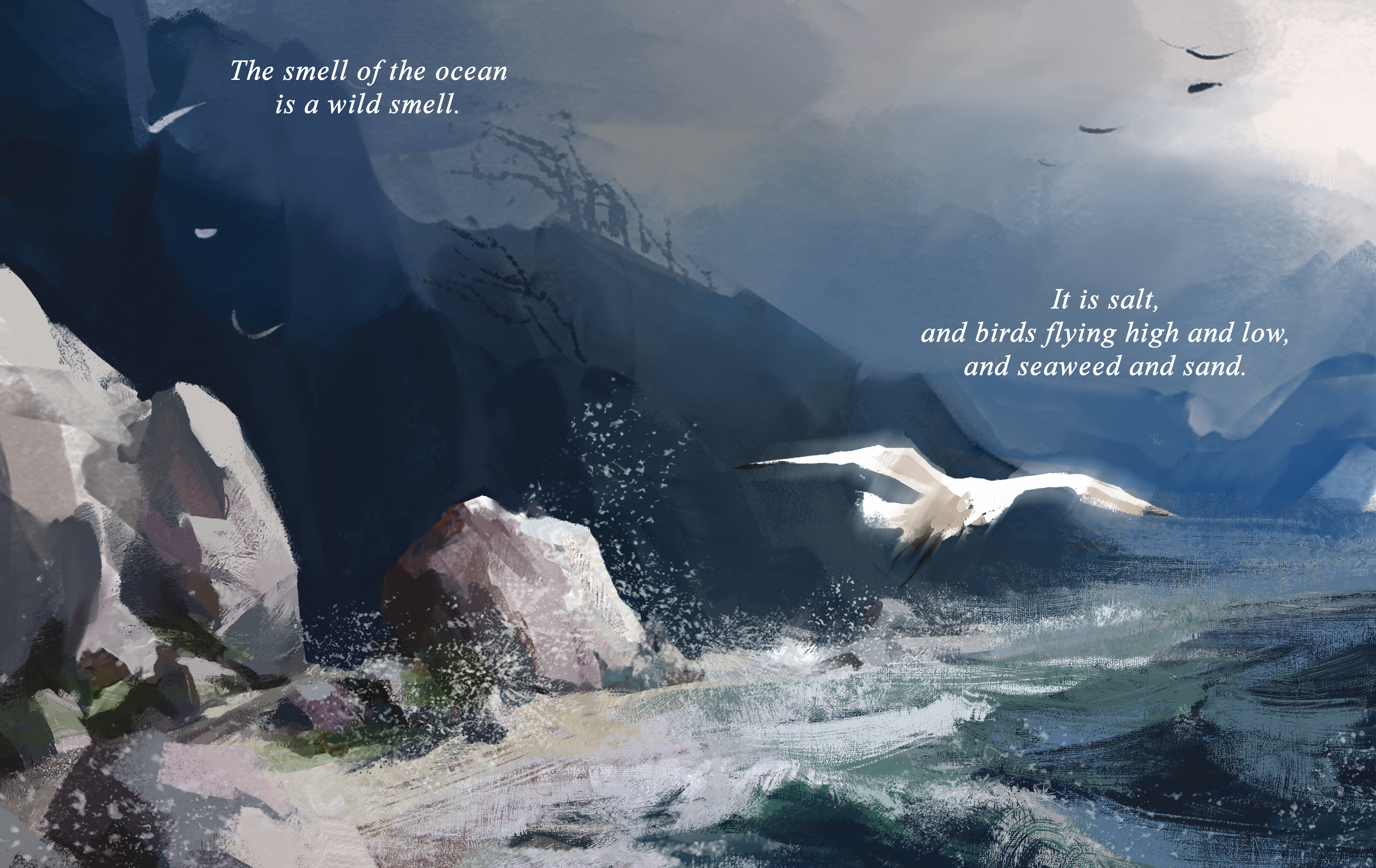
Here, then, are two more of the illustrated spreads featuring illustrator Tomasz Mikutel's breathtaking paintings (and my words).


The following retailers are among those carrying the book.

Amazon

Bookshop (hardcover only, so far)

Books-A-Million (hardcover link)

Powell's Books (both hardcover and paperback, though the book cover doesn't show in the listing)

Barnes & Noble will have it when (I'm guessing) the corrected cover is approved.

Also, your local bookstore should be able to order it. (For reasons having to do with pricing and wholesaler discounts, they may be more eager to order the paperback, but still willing to order the hardcover.) And I'd love to have you ask them, as a few such requests may induce them to carry the book regularly.

Happy reading and art enjoyment, everyone!

Saturday, May 14, 2022

More of the art from WIND, OCEAN, GRASS, and -- what I meant about collector's items

 Here are two more of the illustrated spreads (with words) from my new picture book Wind, Ocean, Grass, to be "released" tomorrow and already available in paperback from Amazon.


And there's so much more! (To be precise, forty more spreads than I've posted here so far.)

Now, about that "collector's item" hint.

After various angst-inducing episodes, I finally had the paperback and hardcover editions finished, uploaded, and approved. So I ordered some author copies . . . and didn't actually proofread the back cover for another few days, at which point I discovered to my horror that there was a typo in the text. It wasn't the sort of typo that leaps out at you, necessarily, but it was there. (I'm not identifying it, for a reason I'll get to it a minute.)

I was able to generate a new back cover pretty quickly -- quickly enough that the paperback edition could still come out on Amazon without delay. However, the hardcover edition, and the paperback edition distributed elsewhere, have a considerably longer maze to get through. In the meantime, copies with the typo have already been distributed to various retailers. Not until the corrected version makes it through the approval process will the distributor even start sending it out. I'm hoping this happens within the next couple of days, but have no guarantees. (It may, for example, be stalled over the weekend.)

So . . . if you buy the hardcover anywhere, or the paperback anywhere but Amazon, you just may be one of the lucky few to obtain the original version, typo included. Presto, a future collector's item! -- potentially, at least.

As for the typo itself: if you buy a copy (again, other than the paperback available from Amazon) before the corrected version completely replaces the original, you can entertain yourself looking for it. Call it a treasure hunt.

Tomorrow, I'll celebrate Release Day by posting more of the illustrated spreads. And once you get hold of the book itself, I promise all the cryptic bits of text you've seen here will make sense.

Friday, May 13, 2022

I Can Call a Picture Book Gorgeous Even If I'm the Author, Because I'm Not the Illustrator

 (Actually, I'm all in favor of people owning their achievements. Theoretically. In practice, I'm . . . getting better at it.)

My latest picture book, Wind, Ocean, Grass, has a release date of Sunday, May 15th, but the paperback is already available on Amazon. And it is gorgeous! Tomasz Mikutel, the illustrator, is a painter, exhibiting in galleries. He calls his style "classic and traditional" but also "loose." I call it -- or at least, the wonderful work in this book -- impressionist, or something close to it.

Here are a couple of the double-page spreads (with text included). See what I mean?


I'll post more tomorrow and on Release Day.

So what is the book about? Well, here's the description I've been using on Amazon and elsewhere.

-----

This unique picture book has neither human nor animal characters, but instead features the wind speaking to the grass, explaining how long grasses are both like and unlike the waves of the ocean. Through lyrical prose and breathtaking impressionist-style paintings, the reader follows the wind’s journey over sea and land: the many moods of the ocean, the different seasons of the grassy field. We see glimpses of the birds that live off the bounty of the ocean, and the birds and flowers that live among the grasses.

Through this nature metaphor, the story, without becoming didactic, teaches children about seeing commonality and celebrating differences.

-----

There are some complications about which versions will be available outside Amazon when. I'll explain next time. Hint: collector's items!

Tuesday, February 08, 2022

A snippet from upcoming-I-hope near-future novel DONATION -- featuring my favorite fictional judge

I hope, and just about believe, that after much dithering and changing course, I'll finally be publishing my near-future novel Donation this coming spring. And here's a snippet.

Donation involves the issues that arise when the federal government controls artificial womb technology. In this scene, federal judge Alexandra (Alex) Rayner examines some papers filed in a lawsuit where a woman who "donated" her embryo (now a fetus) is trying to regain her parental rights, and the Bureau of Reproductive Safety is fighting her tooth and nail.

I adore Judge Rayner. As one character says, she's what I'd like to be when I grow up -- or would be if I weren't more comfortable these days writing books.

--------

Judge Alexandra Rayner sat back in her rocking chair, luxuriously comfortable in her long bathrobe, quilted slippers on her feet – she’d finally found slippers neither too short nor too wide! -- and contemplated the opening motions in what promised to be a most interesting case. Interesting, and in unfamiliar territory: federal judges like herself were rarely drawn into family law disputes. Only the fact that the clinics were established under the aegis of the federal government had brought this matter to her court.

There was, of course, the threshold question: should she recuse herself because of the abortion all those years ago? She thought not. She had made that choice in a very different world, a world with different options and different consequences. That history did not predispose her to take any particular view of the present controversy.

So. The plaintiff wanted the adoption process frozen. Problematic, at least if continued for long, given Alex’s inability to freeze fetal development to match.

The plaintiff also wanted an order giving her access to the incubator, so she could talk to the fetus. Meanwhile, the clinic, should Alex decline to dismiss the case immediately, wanted carte blanche for the chosen adoptive parents to do the same, pointing out that for them to do so was normally routine. (And just when had those parents been chosen? Not that it mattered for her purposes.) She would ask for affidavits from experts about the importance to and effect on the fetus of hearing voices that could eventually be familiar and familial. And what about other voices? Did the nurses, or technicians, or whatever they were called talk to the incubators? How much? Were human voices in general more important than particular voices? Did even the experts know? Well, whether or not they knew, they’d try to sound as if they did.

Hmmm . . . That would be a possible solution. Indeed, uniquely rational. If the affidavits supported the claim that human voices, or the voices of family members, played an important developmental role, then the parties — plaintiff and individual defendants — could supply the same. Separately, and taking turns.

She could wish to be a fly — a temporary and sentient fly — on the wall when these competing would-be parents had their visits. What would they want the fetus to hear? What would they be unable to keep themselves from saying? Such knowledge would be helpful indeed, if her job was to play Solomon and send the baby where it would be best nurtured and loved. But she had no such mandate, and thank God for that.

Though come to think of it, Solomon had been asked to determine, not the best mother, but the true one. Maybe not so far, after all, from her own more legalistic duty.

And this degree of woolgathering meant it was time she went to bed. But first, she would send herself a note as a reminder. If she did order access to the fetus, she had better make sure the clinic did not take advantage of the logistics to record or listen in.

--------

Back to final(??) revisions. Wish me luck!

Sunday, November 28, 2021

The Problem With Pronouns

 I have been struggling for several years to become consistent at using "they/them" pronouns for someone I love, someone I've known almost half my life. During almost all that time, I and others referred to this person with "she/her" pronouns. I don't give a damn what, if any, gender this person is. The struggle arises from other factors.

I grew up speaking English. Like many of you -- including the person in question -- I have studied another language. So I have some appreciation of the profound differences between speaking one's native tongue and speaking a language in which one is not fluent. I believe these differences explain why changing my pronoun usage has been so difficult. Caveat: I'm not a scholar in linguistics or any related science. I'm describing an experience, one which I've done my best to study from the inside. (Second caveat: the English people under thirty-ish have learned may well be more flexible in structure.)

When I speak English, the basic building blocks require no conscious thought or effort. Verb forms, the ordering of parts of speech, and other such features of the particular language I speak -- all these fall into place at what I'll call a pre-conscious level. And from what I can tell, pronouns fall into that category. In the English I learned in the mid-1950s, the English in which I'm fluent, a single known human being takes the "he" set or the "she" set of pronouns. (Unknown humans are another story. I don't know whether, at some time before my era, using "he" for all unknown individuals was automatic, but it isn't for me.)

So, the building blocks are in place. Next comes adding the substance of what I want to say. This does require conscious choices. Even more deliberate is the next layer, one of nuance. Does the word that has come to mind have the right connotation? Is it sufficiently evocative? Will it fall pleasantly on the ear?

The final step, if I'm to use "they/them" for a single known person, amounts to slapping a filter on the top of this stack of words and meaning. It's the very last step before I open my mouth. Indeed, it often comes a fraction of a second later, and what I say comes out with hitches and interruptions, last-minute saves. 

Here's the ironic and most upsetting aspect of this process: the more I care about the content of what I'm saying, the more emotional significance it has for me and for the person I'm saying it to, the harder it is to remember to add that filter. So the more it matters, the more likely I am to sabotage the communication and hurt someone I love.

I understand, at least to some extent, why pronouns matter so much to this person and others like them. (Phew! Got it right that time.) Gender is a deeply personal matter, and being referred to with the wrong pronoun -- at least, for this person and many others -- feels like an attack. They don't see the errant "she" as just a part of speech. They view it as an insistence that what they know and feel doesn't matter. And even if it happens rarely, just knowing that it could happen means that every minute in the unreliable speaker's company is an ordeal of continuous stress.

I wish this person would make their own attempt to understand. And I have a more desperate wish, even less likely to be granted: that they, and others facing the same impasse, could revisit the symbolic heft they accord pronouns. Giving pronouns such power makes no-win situations, broken relationships, and broken hearts nearly inevitable.

Friday, November 12, 2021

A wonderful passage that applies to writing stories

 I just came upon a wonderful quotation in a wonderful book -- Once Upon a Wardrobe by Patti Callahan. It concerns George, an eight-year-old boy who is very ill, and who greatly cherishes C.S. Lewis's The Lion, The Witch and the Wardrobe. (It twinges a bit for me to resist putting in an Oxford comma.)

"George knows you can take the bad parts in a life, all the hard and dismal parts, and turn them into something of beauty. You can take what hurts and aches and perform magic with it so that it becomes something else, something that would never have been, except you make it so with your spells and stories and with your life."

This speaks to me as a writer, and may similarly speak to other writers, and to those wrestling with those hard and dismal parts of life.

Tuesday, October 26, 2021

Release Day!! for picture book WHEN IT'S WINTER

The wait is over! If you like winter, cute kids, cute dogs, and/or picture books with lovely illustrations, I hope you'll check out my newly released When It's Winter with illustrations by Barbara Dessi. I've been previewing pics and text alternately over the last few days (just scroll down), and I hope I've whetted your appetite.

Here's the cover, once again.


Here's the blurb.

"What makes winter special? This picture book celebrates the many fun activities and sensory experiences of the season. Follow a girl and her dog through the play and discoveries of a snowy day, and on toward bedtime.

"The first person narrative will encourage new readers to claim it as their own. The repetition of the phrase 'When it's winter . . .' will encourage children to chime in, and be of assistance to early readers."

And here's the Amazon link! (It may take you to the Kindle edition instead of the paperback I've told it to use, but you can get over to the paperback with one click.)

When last I checked, "Look Inside" wasn't yet functional for the Kindle ebook. If you encounter that problem, feel free to email me at kawyle@att.net, and I'll send you the first couple of illustrations. (You could also "look inside" the paperback, though it'll display single pages, i.e. half of the illustration at a time.) (Of course, you could just buy the book . . . . 🙂 )

Happy reading, all!


Monday, October 25, 2021

One more advance look before Release Day!

 Only one more day before the release of When It's Winter, the picture book on which I collaborated with the wonderful Barbara Dessi! Here's a final advance peek at Barbara's wonderful illustrations.

The book follows a day-long arc, and this image comes close to bedtime. I love everything about it.


Sunday, October 24, 2021

a peek at another line from upcoming picture book

 In keeping with my pattern of alternating looks at art and text in my upcoming picture book When It's Winter, here's another line.

------

When it's winter ... my dog helps me make a snowman.

------

(The illustration for this line is one of my favorites, but you can see that soon enough, with the book's Amazon release scheduled for Tuesday, October 26th.)

Tomorrow, another picture!